Notes on the origin of New Hollywood (fromCinemas of the World)
The emergence of New Hollywood marked a delayed response from the industry to changing audiences and social values.
With the increase in the popularity of television as a medium for visual entertainment, family audiences went to the cinema less often and the primary audience for movies became a 'demographic of males between their mid teens and mid twenties'.
However, the major Hollywood studios reacted slowly to this and continued producing family oriented films which previously had offered stable profits due to mass appeal.
They also continued to use ageing, established film stars like John Wayne, Cary Grant, and Elizabeth Taylor.
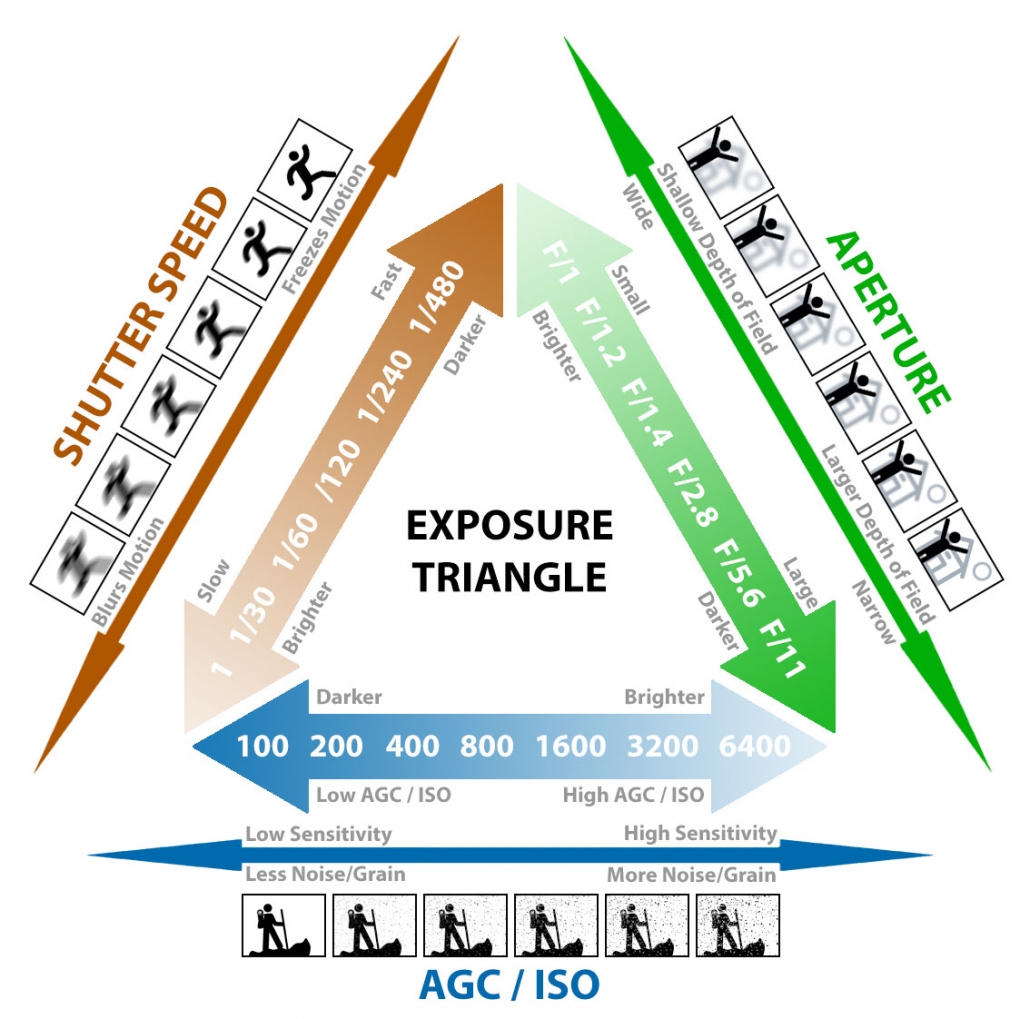
The exposure triangle is made up of three camera settings. These are aperture, ISO, and shutter speed. The relationship between these variables and their effect on image exposure is often represented visually in the exposure triangle (example pictured below).
I filmed a number of short videos to demonstrate how changing each variable effects the recorded footage visually.
Aperture
Aperture is the size of the opening made by the iris to let light into the camera and through to the sensor (digital) or film (analogue). This is measured using F-stop. The lower the F-stop number the larger the aperture. This affects exposure as it controls how much light from the environment reaches the sensor. A lower aperture increases the exposure and a higher aperture lowers the exposure. Hence, footage filmed with an aperture of f/22 will appear much darker to the viewer than footage of the same subject filmed with an aperture of f/2.8 - given no other variables are changed.
Footage filmed with an aperture of f/22.
Footage filmed with an aperture of f/2.8.
The first clip with an aperture of f/22 is under exposed, while the clip with an aperture of f/2.8 is exposed much better despite both clips being shots of the same subject and filmed one after the other with no changes in lighting.
The difference between these clips also demonstrates the effect aperture has on depth of field, which is the range of items in focus in an image (Stubbs, 2021). The f/2.8 clip clearly has a much lower depth of field than the f/22 clip, shown by how the window in the foreground remains in focus while the houses in the background are out of focus, which is clearly different from the f/22 clip which shows both the foreground still i focus and the background more in focus than before. This also means the first clip filmed with a higher aperture has a high depth of field.
Film makers can therefore use the aperture function to manipulate depth of field for creative purposes, like drawing the audiences attention to a specific subject with shallow depth of field, or allowing the audience to take in a carefully constructed scene or background with wide depth of field - both of which being common creative decisions in film making.
For example, in the following sequence from M. Night Shyamalan's Old (2021), low depth of field is used to hide the children's new appearance from the audience by having them out of focus in the foreground, and focussing on the reaction of the adults which further builds up the intrigue of the audience and allows for a shocking reveal towards the end where camera switches to the perspective of their father who has just walked into the scene. Thus, as a result of Shyamalan's use of depth of field, the audience is able to empathise emotionally with the father and experience the same shock.
ISO
ISO is a camera setting that artificially increases the camera sensor's sensitivity to light, mimicking the use of extra sensitive film in analogue cameras, to increase exposure. This makes footage shot in low light conditions appear more exposed. However, increasing the ISO can have the side effect of adding noise to the picture - a result of increased gain. This effect becomes more noticeable as the ISO value increases. Here are a few examples:
The above video was shot at ISO 200 indoors with average lighting. The picture is detailed with very little noise present. (Parts of the video are not well focused as I moved away from the subject while filming, I would correct this if doing the exercise again).
The above video was shot at ISO 1600 with the same lighting conditions as the previous clip (although other settings may have been changed too as the exposure appears similar) and demonstrates the increased noise present when shooting at higher ISO values.
The first half of the following clip further demonstrates increased noise as we shot it in low light with a significantly higher ISO of 6400:
Due to the effect of increasing noise, ISO is generally the last setting a photographer or videographer changes to increase the exposure of their footage. However, it has a crucially important application in shooting in low light conditions such as concerts or when shooting night time scenes outside, where there may be little choice over how dark the environment is. Furthermore, many high-end DSLR cameras are designed to minimise the amount if noise picked up by the sensor, allowing for better quality footage to be shot in low light conditions.
Shutter Speed
In a camera, the shutter is 'the physical device that opens and closes to let light from the scene strike the image sensor' (Stubbs, 2021). Shutter speed is a camera function that changes how fast the shutter closes. A higher shutter speed results in a lower exposure as it reduces the length of time the sensor is exposed to light, conversely a lower shutter speed increases the exposure as the sensor is given more time to gather light before the shutter closes again.
Like ISO and aperture, shutter speed also has an additional effect. At slower shutter speeds the resulting video will have noticeably more motion blur because the sensor is exposed for longer and 'sees' more movement in each frame, whereas a higher shutter speed results in clearer video with less motion blur and can allow for freeze frames that show clear images.
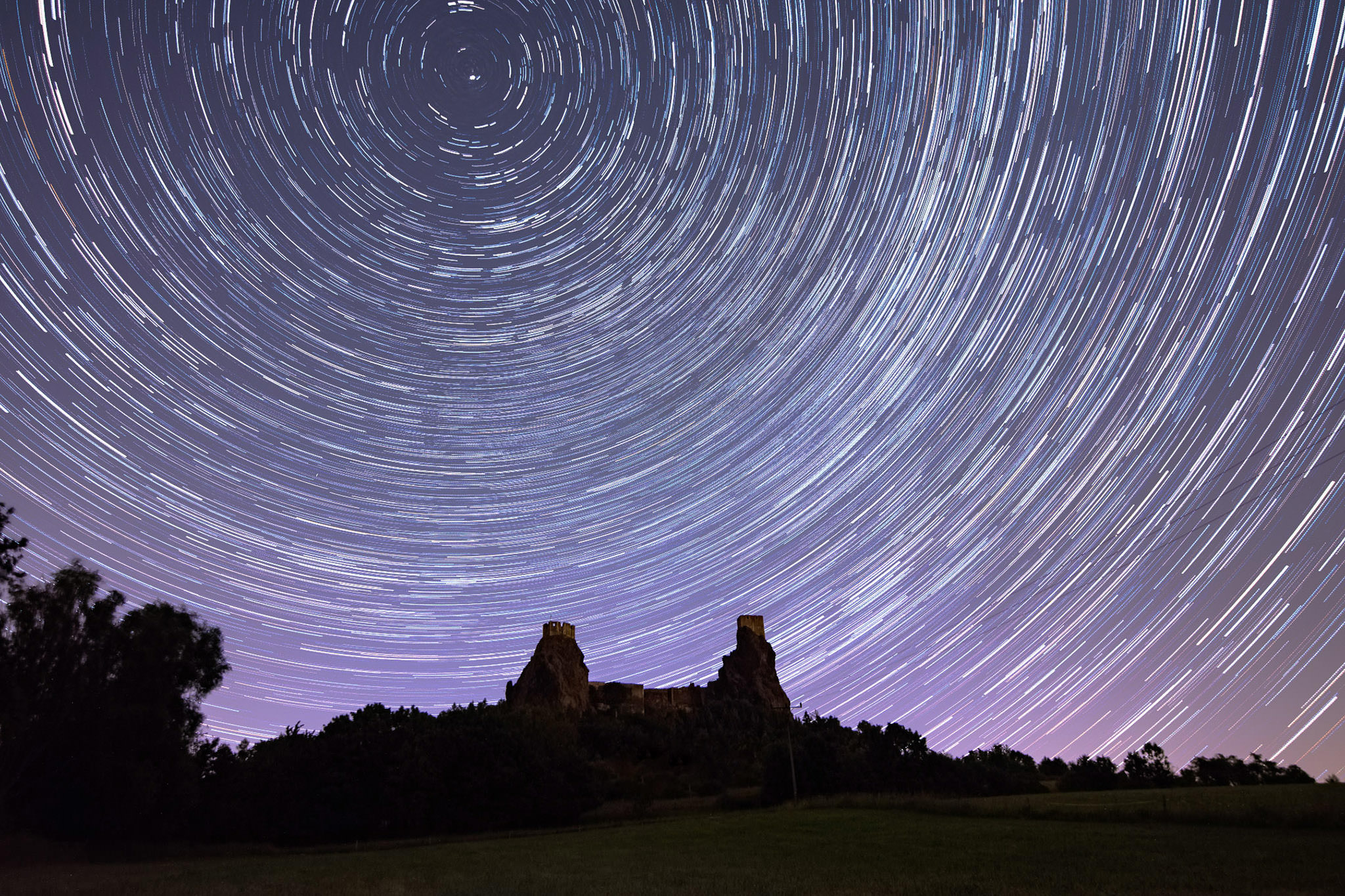
This side affect of shutter speed has practical uses as film makers may wish to add motion blur as a stylistic choice. For example, to convey the speed of a fast moving object through motion blur. On the other hand, fast shutter speeds are very good for capturing fast action such as fighting in an action movie, animals in wildlife photography, or action in sports photography where accuracy is key. Another application of slow shutter speed is at night to capture stars, particularly star trails in long exposure photography.
The following clips demonstrate the effects of shutter speed.
Shutter speed of 1/30
The above shows motion blur created by low shutter speed. And this is especially visible when looking at a snapshot from the video:
The moving subject is blurred while the background, which is static, remains clear.
This is noticeably different to a clip filmed with a higher shutter speed setting such as the following which was filmed with a shutter speed of 1/125:
Shutter speed of 1/125
The motion of the subject, which is the same speed as before, is now considerably less blurred and instead much more clearly defined. This is further demonstrated by the snapshot.
Bibliography:
Stubbs, N., 2021. Digital Dictionary, A Glossary of Photographic Terms.
[online] All-things-photography.com. Available at:
<https://www.all-things-photography.com/digital-dictionary>
[Accessed 2 December 2021].
Old. 2021. [film] Directed by M. Shyamalan. United States: Universal Pictures.
There were 3 phases of the American New Wave: the New York New Wave of the 1950s, New Hollywood, and a 3rd new wave in the 1980s and 90s.
The New York New Wave primarily were "concerned with realism and a truthful depiction of American society at the time" with works like Lionel Rogosin's On the Bowery which depicted the poverty near is home, using real homeless people to play themselves. He funded this independently.
Before cutting, motion pictures were essentially continuous, unedited films of
something similar to a stage play. The camera would capture everything in the
same shot. Cutting involved the physical cutting up of reels of film in order
to skip or remove sections of the recording. This allowed film makers to experiment with films that had multiple shots. One if the first multi-shot films was Come Along Do! directed by Robert W. Paul. It was made up of two shots, the second of which showing continuity from the first.
Later, film makers would make more complex use of cutting, such as Voyage Dans Le Lune by Georges Méliès where he used jump cuts to make objects and characters appear and to imply action that is unseen, such as the famous shot of the rocket hitting the face of the moon.
Moviola
The Moviola was a device that allowed editors to view film as they edited it so they could work out the best place to make a cut. It was invented by Iwan Serrurier in 1924 and became the most popular method of editing film - a position held by the Moviola until the 1970s.
Flatbed Edit Suites
The flatbed editor was a editing machine that used motorised discs called plates to hold and manipulate film. There was a plate for visual film and one for magnetic audio tape. The plates can move independently or locked together after picture and sound have been synchronised. It used a prism to reflect the film image onto a viewing screen. The flatbed was much easier to use than the Moviola, so it made editing much more accessible to independent film makers.
Linear and Non-Linear Editing
Linear editing is a term mostly associated with editing using video
tape. In linear video editing, edits must be made in sequence and it is
very difficult to make changes later. This is because editing with video
tape involves recording selected sections of the source tapes onto a
master tape. If they editor wanted to make a drastic change to a
previous part of the master tape then they would have to start again
fresh or rerecord over all of the old footage, with the latter causing a
loss in quality.
This style of video editing was necessary
during the time that video tape was the most common medium for video
recording. Editing with film was somewhat more flexible as it could be
physically cut and rearranged, something not possible with video tape.
Linear editing fell out of common use with the rise in popularity of non-linear editing computers.
Non-linear video editing refers to editing using a non-linear system
such as Avid or the more modern option of an editing program on a pc
such as Adobe Premier Pro, Lightworks, or Final Cut Pro.
As video
data is stored digitally and can be randomly accessed by the computer,
the editor can assemble clips and make changes in any order they like.
This makes editing much easier and therefore more accessible to
everyone.
Non-linear video editing is the most common type of
editing used today both professionally in studio productions and by amateurs and hobbyists, although older mediums of recording and editing
styles are not completely obsolete.
Offline and Online Editing
Offline video editing is the first stage of editing where lower resolution copies of the raw footage are imported into an editing suite. Cuts are made and takes are assembled so that the overall structure and flow of the production is established. The changes made to the footage are recorded in an edit decision list.
More complicated edits such as colour grading, special effects, and sound mixing are made in the online editing phase.
Historically this was done using copies of video tape.
The Digital Era
The first digital non-linear editing system was the CMX-600 introduced in 1971. It was a two monitor machine mainly used for offline editing due to the low quality it worked on. So editors would use the CMX-600 to create an edit decision list that would be passed on to online editing.
Another non-linear video editing system was the Edit Droid of 1984. It was produced by Droidworks which was a spin-off company of Lucas Film. The Edit Droid was not a commercial success, but it did represent a jump in technology in the field as it was laserdisc based, an upgrade from the disk pack drives of the CMX-600. The software of the Edit Droid was also pioneering as it was the first editing suite to use a 'timeline' to organise clips, a tool which is standard in modern editing suite programs.
The Avid 1 was another digital non-linear editing system. It was based on a Macintosh computer with special hardware and software made by Avid. It became popular in the 1990s and replaced much older linear systems as the new most common professional system.
Modern Editing Platforms
Modern editing suites come in the form of software which can be installed on any computer that has sufficient hardware for video editing. The most popular ones are Adobe Premier Pro, Apple's Final Cut Pro, Sony Vegas, and Lightworks. Many of these packages are affordably priced and have accessible minimum hardware requirements, making video editing more accessible than ever as it no longer requires a massive investment. However, it should be noted that higher end productions and a better workflow can be achieved with more expensive hardware.
Types of Film Stock
Film stock is the original material used to record images and motion pictures. The first variation was developed by The Eastman Company in 1889 and it was an important component of Thomas Edison's motion picture camera.
There is a wide variety of different film stocks. Different types are often differentiated by their gauge in mm and the varieties in their perforations. Variations include 8mm (and Super 8), 16mm, 35mm, 65mm, 70mm and more.
Digital video comes in different file types. The file type affects how the data is encoded and stored, known as the codec and container. A more efficient codec compresses data to reduce the file size while preserving quality.
.WEBM is a file format created by Google and is commonly used for online video streaming, most notably on Youtube. It is designed to keep file sizes small and so compromises on quality.
.MPG, .MPEG and other similar formats can play audio and/or video. They use lossy compression so are better for storing video that will not be edited many times or not at all, as quality will be lost each time.
.MP4 can also play audio and video. They are widely used in online video streaming alongside .WEBM but are generally higher quality and therefore have larger file sizes.
.AVI is one of the oldest video file formats and is therefore one of the most widely compatible and flexible.
.MOV and .QT were developed by Apple for use with their QuickTime player and are therefore more suited for use on Mac computers than Windows. They are good for higher quality video.
Sources:
Filmmaker IQ. The Journey to Non-Linear Editing (Part 2). (2013)
moviola.com. The Moviola Story. Retrieved from: https://web.archive.org/web/20120308230830/http://moviola.com/book/export/html/12v
Schrader, P., 2014. Game Changers: Editing. [online] Film Comment. Available at: <https://www.filmcomment.com/article/game-changers-editing/> [Accessed 29 September 2021].
Mediacollege.com. Linear Video Editing.https://www.mediacollege.com/video/editing/linear/
Motionelements.com. Understand Linear vs Non-Linear Editing.https://www.motionelements.com/blog/articles/understanding-linear-vs-non-linear-editing
Aipcinema.com. KODAK FILM HISTORY. Retrieved from: https://web.archive.org/web/20130515033307/http://www.aipcinema.com/ficheiros/Conteudos/KODAK_FILM_HISTORY.pdf
Filestack. The Complete List of Video File Formats and Codecs for Developers. (2019). Retrieved from: https://blog.filestack.com/thoughts-and-knowledge/complete-list-audio-video-file-formats/